
Pian Upe protects one of the last intact dryland savannah ecosystems in Uganda: grassland, woodland, and wetland that, at their ecological peak, supported wildlife populations comparable to East Africa's greatest reserves.
That peak has not yet been restored. But the trajectory is pointing upward. Since active management began in 2022, wildlife populations are growing across multiple species. Monitoring systems are now producing individual-level data on key species. And the landscape itself, productive, expansive, and ecologically capable, is showing the first signs of returning balance.
The peak is not restored. The trajectory is upward.
Wildlife of Pian Upe
7 key speciesSeven species anchor the recovery story. Some are counted in their thousands, some are known individually by name, and one survives nowhere else in Uganda.
Pian Upe once held nearly 900 giraffe. By the 1990s they had vanished entirely. In 2019 and 2020, 29 animals came home with the Giraffe Conservation Foundation, and today 52 hold their own ground on these plains.
One of the world's most endangered giraffe, the Nubian giraffe was reintroduced to Pian Upe in 2019 and 2020, 29 animals in total, in partnership with the Giraffe Conservation Foundation and UWA. The herd has grown steadily since, and every animal is individually identified through a growing photographic database: as of 2026 the reserve holds 52 catalogued animals. Uganda holds roughly 60% of the world's remaining Nubian giraffe, which makes this recovering herd a meaningful part of the species' future.

How the Nubian giraffe returned to a landscape that had none.

Pian Upe holds Uganda's only remaining population of roan antelope, a globally significant conservation responsibility. These large, striking antelope are found in vanishingly few locations across East Africa, and their continued presence makes the reserve uniquely important to regional biodiversity.
A small population, currently estimated at around 17 identified individuals and of serious conservation concern: one of only a small number of sites in Uganda where the species is confirmed present. Camera traps and direct sightings are building an understanding of population dynamics.
The 2025 aerial survey recorded more than 1,800 common eland, one of the reserve's most numerous large herbivores and an indicator of the landscape's capacity to support big-bodied grazers when managed well.
More than 2,100 Jackson's hartebeest were recorded in the 2025 survey, a marked increase on 2023 and the largest single-species count in the census.
One of Pian Upe's rarest and most remarkable residents: a shy, nocturnal, scale-covered mammal and the largest of the world's pangolin species. Pangolins are the most trafficked mammals on Earth, which makes every individual here precious and the reserve's protection work a matter of global significance. Sightings are exceptional; that quiet presence is one of Pian Upe's best-kept secrets.
Cape buffalo once moved through Pian Upe in their thousands. Around 389 remain today, and numbers have dipped in recent years, but as one of Africa's classic large grazers and a keystone of a healthy savannah, the recovery of these herds is a clear priority and a barometer of the grassland's return to health.
The reserve also supports oribi, topi, bohor reedbuck, waterbuck, common duiker, warthog, ostrich, Burchell's common zebra, Cape buffalo, impala, baboon, sitatunga, leopard, pangolin, hippo, and a wealth of smaller mammals and reptiles. Leopard range widely across the reserve, and a 2022 camera survey identified 14 individuals. In all, Pian Upe supports 163 mammal species, among the broadest diversity of large plains mammals anywhere in Uganda.

Lake Opeta
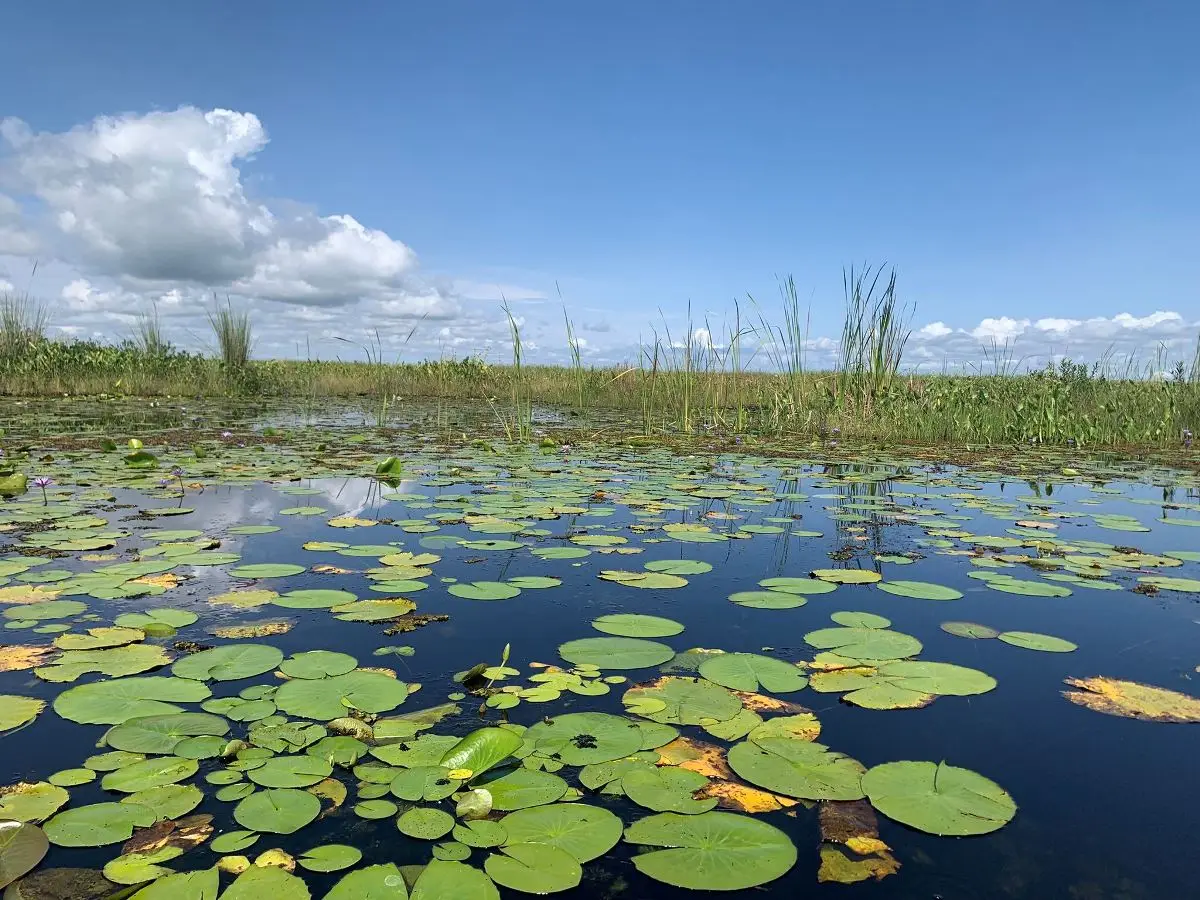
A vast seasonal wetland on the reserve's western edge, recognised as a Ramsar site of global significance, a landscape that transforms from one season to the next.
Opeta's floodplains, papyrus swamps, and open water form one of the most important wetland systems in the region. Their flooding and drying through the year shapes the movement of wildlife across the whole landscape.
The lake draws an exceptional concentration of birdlife, including shoebill storks, the rare Karamoja Apalis, and Uganda's only country-endemic bird, the Fox's Weaver, found nowhere else on Earth.
Birds of Pian Upe
One of Uganda's great frontier birding destinations: globally significant species, seen without the crowds.
The prehistoric-looking giant of Lake Opeta's wetlands, and one of the most sought-after birds in Africa.
Uganda's only endemic bird, found nowhere else on Earth.
A rare warbler that shares its name with the region itself.
Two striking, ground-striding hunters of the open plains.
Four Critically Endangered vultures, the Endangered Martial Eagle, and the migratory Pallid Harrier.
Saddle-billed and African Woolly-necked storks, hornbills, sunbirds, and a wealth of savannah species.

The 286 birds confirmed in the 2024 and 2025 surveys, across 60 families.

When an animal is found injured or trapped
Monitoring is not only counting. The team responds to animals caught in snares, stuck in dry wells, or injured on the road: veterinary support, extraction, treatment, and release back into the reserve.
Habitats and ecology
four systems, one landscapegrassland
Restoration here means managing fire, growing herbivore pressure, and exploring managed grazing where legally aligned.
Vast open plains of mixed grasses that, in ecological balance, can support enormous densities of grazing wildlife.


Woodland condition is monitored and managed as part of the broader habitat restoration programme.
Whistling thorn and desert date give shade, browse, and structure, for giraffe, kudu, impala, and a diversity of birds.


Protecting these systems is central to the reserve's ecological integrity.
Critical water for wildlife and communities alike, supporting hippo, sitatunga, waterfowl, and a wide range of aquatic species.


The dramatic outcrops give Pian Upe its distinctive visual signature.
Habitat for mountain reedbuck, leopard, klipspringer, and a variety of raptors, rising straight out of the plains.


